Watch It First
There is a version of this article where I try to convince you the Ibanez TS9 is some hidden gem nobody has heard of. That would be a lie. Everyone has heard of it.
Stevie Ray Vaughan basically ran his entire Fender rig through one. Gary Moore used it to push his Marshalls into that thick, singing lead tone. It has been sitting on pedalboards since the early 80s and, somehow, it still has not been dethroned.
So the question is not „does the TS9 work” — obviously it does. The question is whether it is still worth buying today, in a market absolutely flooded with clones, boutique tweaks, and cheaper alternatives. Let’s find out.
What the TS9 Actually Does
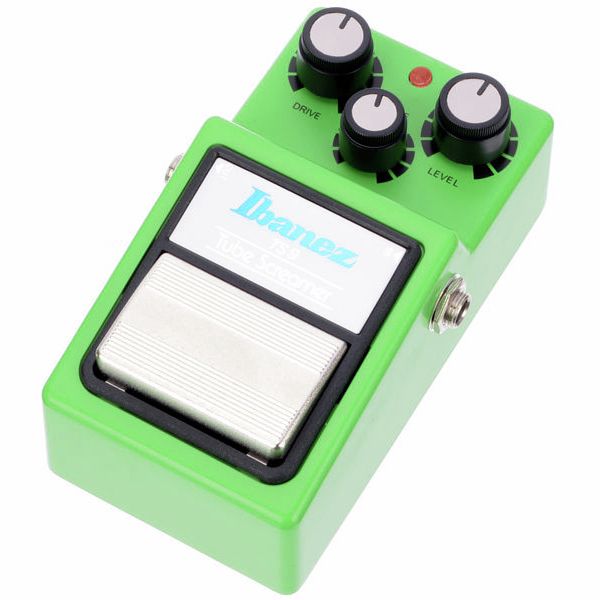
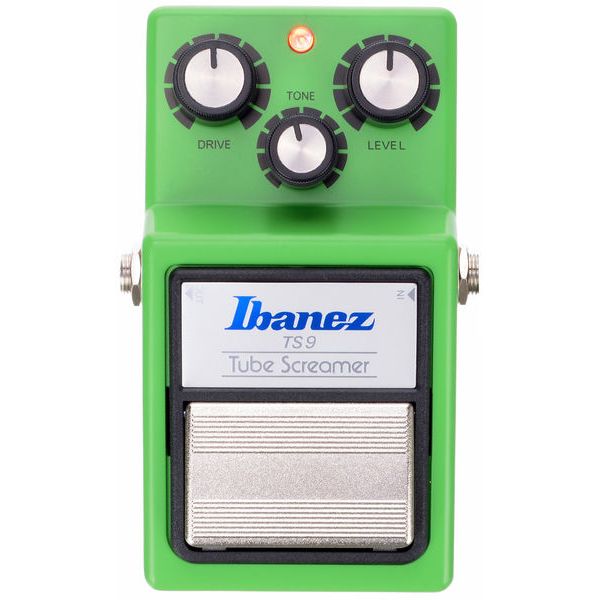
Three knobs: Drive, Tone, Level. That is the whole interface, and it has stayed basically unchanged since the original TS808 launched decades ago. The TS9 is the direct successor, tweaked slightly but built around the exact same idea.
It is a mid-hump overdrive — instead of adding harsh gain across the whole frequency spectrum, it scoops the lows and highs slightly and pushes the midrange forward. That is the „Tube Screamer sound” everyone talks about: warm, vocal, and great at cutting through a band mix without getting harsh.
Not a High-Gain Pedal
Worth being clear about this upfront: the TS9 does not do metal-style saturation on its own. Even with Drive maxed, it stays relatively polite compared to something like the JHS Angry Charlie. That is by design, not a flaw — it is meant to push an already-driven amp harder, not replace one.
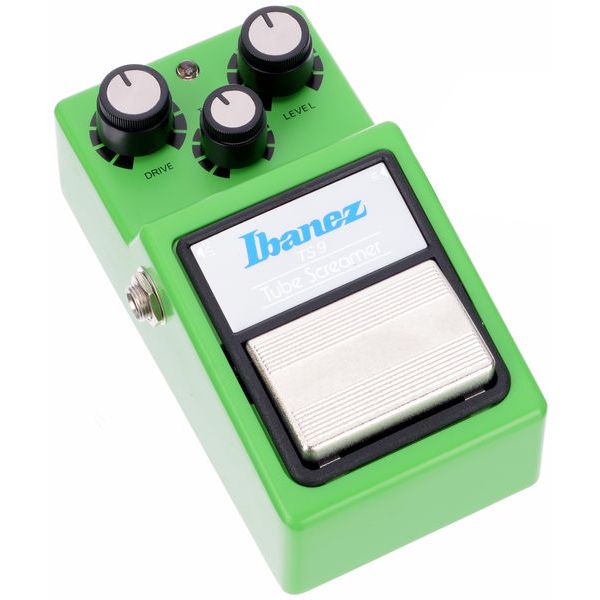
Build quality is exactly what you would expect from a pedal that has survived four decades of touring abuse without a major redesign — a heavy die-cast enclosure, simple top-mounted jacks, and a footswitch that just works. Nothing about it feels like it needs babying.
One more thing worth knowing: because it has been in continuous production for so long, used and vintage units are everywhere, and opinions on exactly which production run sounds „best” could fill a forum on their own. For most players that rabbit hole is not worth going down — a current-production TS9 gets you 95% of the magic without the vintage-hunting headache.
How People Actually Use It
The classic move: set your amp for a slightly broken-up clean or light crunch, then kick the TS9 in for solos or choruses. It tightens up the low end, boosts volume, and adds just enough grit to make a lead line pop without turning into mush.
It is also famous as an „amp sweetener” — some players run it always-on, Drive rolled almost all the way down, Level pushed up, just to shape the front end of their amp before it even starts distorting. That trick alone justifies owning one, honestly.
Pairing With Other Pedals
Stack it after a fuzz to tighten up flabby low end, or run it into an already-dirty amp channel for that classic SRV-style push. It also plays nicely with a simple clean boost like the MXR Micro Amp ahead of it in the chain, if you want extra volume on top of the mid-hump without changing the character further.
Who’s This For
Blues, rock, and classic rock players first and foremost — this is the pedal that basically defined that sound for decades. It also earns a spot on jazz boards for its ability to add warmth without sounding like a „rock pedal,” and it pairs well with Vox-style amps looking for that little extra push.
If you play through a genuinely clean amp and want your only distortion source, this probably is not it — it needs an amp that is already doing some of the work. Metal players chasing high-gain saturation should look elsewhere entirely.
Honest Niggles
- It adds a bit of hiss/noise at higher Drive settings — more than a few long-term owners mention it, especially into high-gain amp channels.
- Not much gain on tap. If you want a genuine distortion pedal rather than an overdrive/booster, the TS9 will disappoint — it is simply not built for that job.
- The eternal TS9 vs TS808 debate is mostly internet noise — differences are subtle (a different clipping chip in vintage units), but plenty of players cannot actually tell them apart blind.
- Basic control set. No internal trim pots, no mode switches, nothing fancy. Some players will want more flexibility than three knobs offer.
TS9 vs the Rest of the Tube Screamer Family
Ibanez sells several versions side by side: the TS808 (the vintage-spec reissue, slightly smoother), the TS9DX (adds extra modes and more gain on tap), and the tiny Tube Screamer Mini (same circuit, smaller footprint). The plain TS9 sits in the middle — the most balanced, most „known quantity” option of the family.
Compared to a transparent-style overdrive like the Wampler Tumnus Deluxe, the TS9 is not trying to be transparent at all — that mid-hump colouration is the whole point. Pick the TS9 if you want that specific vocal push; pick something Klon-style if you want your amp’s own character left more intact.
Specs at a Glance
- Type: Overdrive pedal for electric guitar
- Controls: Drive, Tone, Level
- Circuit: Classic mid-hump Tube Screamer voicing, successor to the TS808
- Housing: Sturdy floor pedal, classic early-80s Ibanez design
- Power: 9V battery (included) or 9V DC power supply (not included)
- Notable users: Stevie Ray Vaughan, Gary Moore, and a genuinely enormous list of others
Final Verdict
The Ibanez TS9 is one of those pedals that is famous for a reason, not just hype. That mid-hump push, the way it tightens and warms an already-driven amp, is a genuinely useful tool that has not been meaningfully improved on in over 40 years — plenty have tried.
It will not do everything. It is not a high-gain distortion pedal, and it needs an amp with some character to really shine. But as a blues and rock overdrive, or as an always-on amp sweetener, it remains close to the default recommendation for good reason. Sometimes the classic really is the classic because it just works.