Watch It First
Everyone’s first fuzz pedal is either a mistake or a revelation. There’s rarely an in-between.
At the price of a decent lunch, the Behringer SF300 Super Fuzz is aimed squarely at people who want to find out which one it’ll be without risking real money.
I plugged it in expecting cheap-and-nasty. That’s… not quite what happened.
What You Actually Get for the Price
Three voicings live under a single mode switch: Classic Fuzz, Grunge, and Gain Boost. Classic is your vintage-style splatty fuzz, Grunge scoops the mids and gets thicker, and Gain Boost is closer to a hot-rodded overdrive/fuzz hybrid than a „true” fuzz.
Controls are basic on purpose – Gain, Level, and a 2-band EQ. No parameter fatigue, no tone-shaping rabbit hole. Plug in, turn two knobs, done.
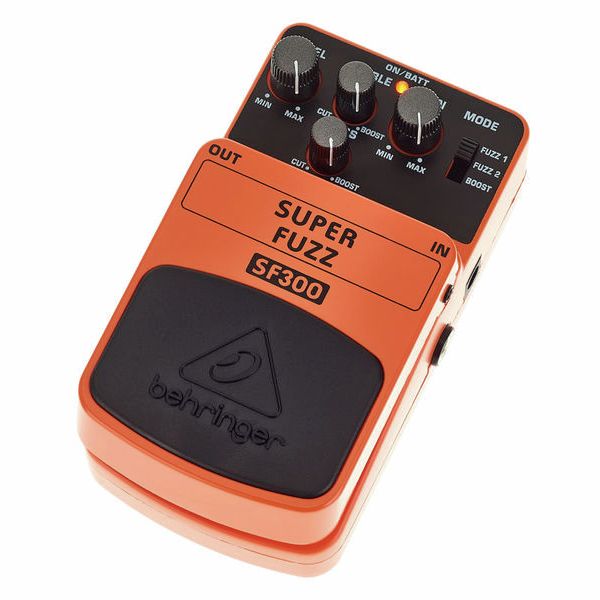
Tone – Where the Money Actually Went
Classic and Grunge Modes
Classic Fuzz mode nails the „fuzzy, slightly broken” thing reasonably well. It’s not going to fool anyone into thinking it’s a vintage Superfuzz, but it’s genuinely useable for garage rock, grunge riffing, or anything that wants a bit of gritty character rather than precision.
Grunge mode is the one I kept coming back to. It scoops just enough mid to feel period-correct for 90s alt-rock without turning to complete mush, and it stacks well in front of an already-dirty amp channel.
Gain Boost Mode
This is less „fuzz” and more „aggressive dirt pedal.” It’s the most usable mode if you’re playing in a full band mix rather than solo, since it retains more note definition than the other two.
None of the three modes are subtle. This isn’t a transparent boost or a low-gain overdrive like an MXR Timmy – it’s a fuzz pedal, and it behaves like one at every setting.
Build Quality – The Honest Bit
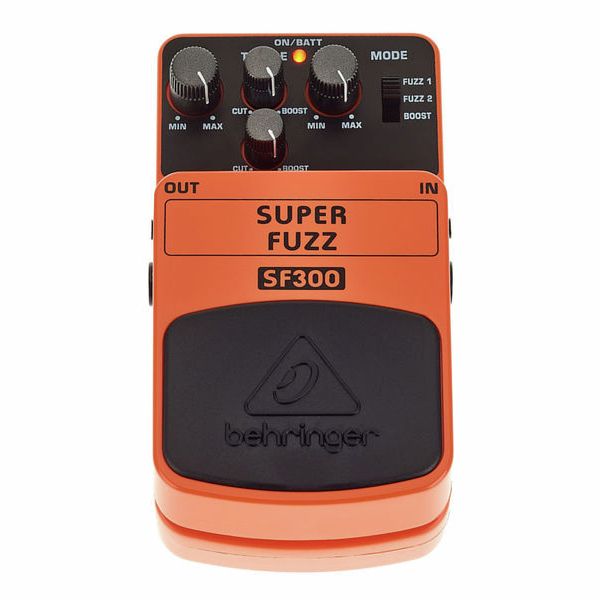
This is where the price becomes obvious. It’s a standard-sized metal enclosure, true bypass switching that’s a bit clunky underfoot, and battery/PSU power – the PSU is sold separately, so budget for that too.
It won’t survive being thrown around a tour bus for a decade. For home use, practice, and the occasional gig, it’s held up fine in my experience, and the community reviews back that up – most complaints are about tone preference, not reliability.
Who’s This Actually For?
Anyone testing the fuzz waters for the first time without wanting to gamble real money on it. Bedroom players who want a grungy, lo-fi texture without building a whole pedalboard around it. Anyone who already has a decent overdrive – something like a Fender Pugilist Distortion or an MXR Timmy – and wants a genuinely different texture rather than another flavor of the same drive.
It also works surprisingly well for indie and lo-fi textures – check our best pedals for indie rock list for other options in that vein.
If you gig constantly and need bulletproof hardware, or you’re chasing a very specific vintage fuzz tone, spend more. This is a „does the job, costs almost nothing” pedal, and it knows it.
The Niggles
The biggest complaint across owners is the lack of an included power supply – factor that into the actual cost before you order. The footswitch also has a slightly mushy feel compared to premium options, and the plastic-feeling knobs won’t impress anyone who’s used to boutique gear.
None of this outweighs what you’re actually paying. At this price, „good enough and then some” is a genuine compliment.
Specs at a Glance
- Fuzz pedal for electric guitar
- 3 voicing modes: Classic Fuzz, Grunge, Gain Boost
- Separate Gain and Level controls
- 2-band EQ
- Powered by 9V battery or external PSU (not included)
- Available since June 2007
How It Compares
Within Behringer’s own budget stomp lineup, the SF300 sits alongside things like the HD300 Heavy Distortion and TO800 Vintage Tube Overdrive – all cut from the same „clone the classics, sell them cheap” cloth. It’s not trying to be original. It’s trying to get you 90% of the way to a famous fuzz tone for a fraction of the price.
Against boutique fuzz pedals costing five or ten times as much, it obviously loses on refinement and dynamic touch-sensitivity. But most beginners can’t hear that difference yet anyway, and by the time you can, you’ll know exactly what you want to upgrade to.
Living With It Day to Day
A pedal this cheap invites skepticism, so I ran it through a few different rigs before writing any of this down – a Strat-style single coil setup, a humbucker-loaded rock guitar, and straight into an interface for recording. It behaved consistently across all three, which honestly surprised me more than the tone did.
Single coils push it into a thinner, spikier fuzz that works well for garage and surf-adjacent stuff. Humbuckers thicken everything up fast, especially in Grunge mode, to the point where you’ll want to back off the Gain knob a fair bit compared to where you’d run a boutique fuzz.
Recording direct, it’s noisier than a premium pedal, as you’d expect. Nothing a noise gate or a bit of gain staging discipline can’t handle, but worth knowing if you’re tracking quiet parts.
Final Verdict
For the price of a few coffees, the SF300 punches well past what it has any right to. It’s not going to replace a boutique fuzz on a pro pedalboard, but for beginners, bedroom players, or anyone who wants a cheap, genuinely fun second fuzz option, it’s hard to argue with.
Check out our best Behringer pedals roundup if this one’s got you curious about the rest of the lineup, or browse our best pedals for grunge list and best pedals for metal list if you’re building out a full board.