Watch It First
This pedal is tiny. Smaller than a pack of playing cards, basically.
And yet it’s one of the most respected compressors in the game, sitting on boards next to units three times its size.
Turns out size and quality have nothing to do with each other. Who knew.
What It Is, Really
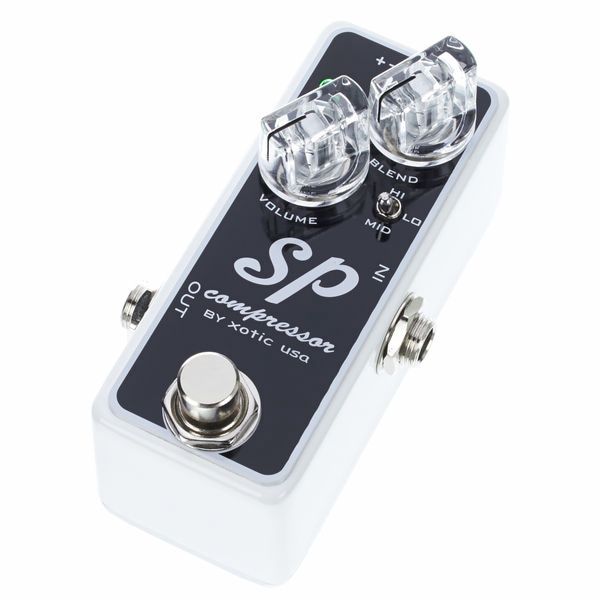
The SP Compressor is Xotic’s take on the legendary Ross Compressor circuit – the same DNA behind a huge chunk of the „invisible” compressors session players have relied on for decades.
Controls are deceptively minimal on the outside: Volume and Blend on top, plus a 3-position rotary switch for compression amount. Pop the back off and there are DIP switches inside for adjusting attack time, which is a nice touch for a pedal this size.
Up to 15dB of clean boost available too, so this isn’t just a compressor – it doubles as a volume/lead boost if you need one.
A bit of background on why this circuit matters: the original Ross Compressor from the late 70s became a cult favourite among Nashville session players, largely because it added sustain and evenness without colouring the tone in any obvious way. Original units go for silly money on the used market now. Xotic basically took that formula, shrank it down, added the blend control the original never had, and made it affordable again.
How It Actually Feels to Play
This is where the SP earns its reputation. The Blend knob is the whole story – it lets you keep your pick attack intact while still getting the evening-out effect compression is supposed to give you.
Most cheap compressors squash your dynamics into a flat, lifeless mush. This one doesn’t. Dial the blend back and you barely notice it’s on – until you turn it off and realize how much more consistent your playing sounded a second ago.
It’s genuinely excellent on bass too. If you’re running something like a Warwick RockBass Star Bass, the low compression setting tightens up your low end without flattening the tone into paste.
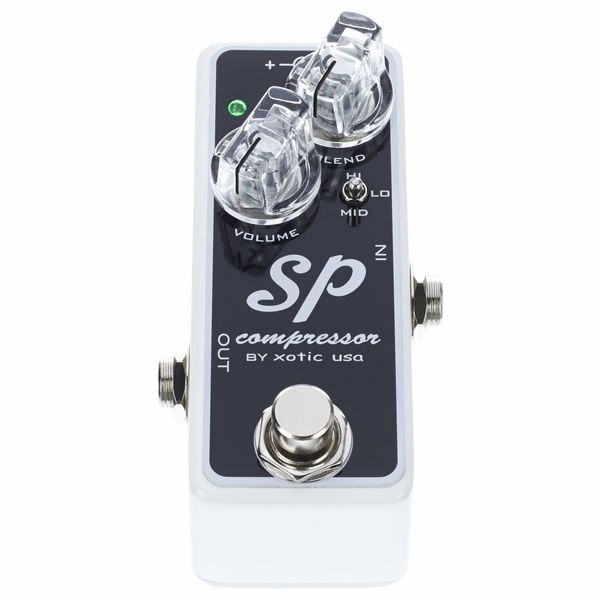
The 3-position compression switch is worth understanding before you buy. Low setting is barely-there, more of a tone thickener than a squash. Medium is the sweet spot most players land on for everyday use. High gets into proper studio-compressor territory, useful for smoothing out an inconsistent picking hand or taming an especially dynamic acoustic-electric setup.
Build Quality and Practical Stuff
True bypass, metal housing, and it takes a 9V battery as well as standard DC power – genuinely handy if you’re building a minimalist board and don’t want a power supply dedicated to one tiny pedal.
The footswitch has a soft, quiet action, which is nice, but a few players have found the pedal sits fairly tall for its footprint – easy to accidentally step on if your board is cramped.
Weighs next to nothing at 260g without the battery, so it won’t add any meaningful bulk to your rig either way.
One more practical note: the internal DIP switches also let you tweak attack time, which changes how quickly the compression kicks in after you hit a string. Faster attack tames pick transients more aggressively, useful for slap bass or aggressive funk strumming. Slower attack lets the initial pluck through before the compressor grabs the sustain, which a lot of clean-tone players actually prefer since it preserves your natural attack.
Who’s This For?
- Session and studio players who need transparent, musical compression
- Anyone tight on pedalboard real estate
- Funk and country players wanting that classic quack without going overboard
- Bass players looking for tighter low end without losing character
Jazz players tend to love this style of compressor too – it’s the kind of subtle tool that shows up a lot in our guide to the best guitar pedals for jazz, where transparency matters more than obvious effect.
The Honest Niggles
The DIP switches for attack time are inside the pedal, meaning you need a screwdriver and a bit of patience to adjust them. Not a dealbreaker, but not exactly gig-friendly if you want to tweak on the fly.
Because it’s so subtle by design, players wanting an obvious, squashed „spank” compression sound might come away a bit underwhelmed. This is a tool for finesse, not drama.
Also worth noting – it’s a mini pedal with a tallish footswitch, so board placement matters more than usual. Give it some breathing room or you’ll be hitting it by accident mid-song.
How It Compares
Against bigger, more feature-heavy compressors, the SP wins purely on footprint-to-quality ratio. You’re not getting an XLR out or a built-in overdrive like on the JHS Pulp’n Peel, but you are getting studio-grade transparency in a package smaller than most tuner pedals.
Pair it with something like an MXR Custom Shop Timmy for a compressor-into-overdrive combo that stays clean and articulate even at higher gain, or run it ahead of a DigiTech Whammy 5 to keep pitch-shifted notes tracking cleanly.
Specs at a Glance
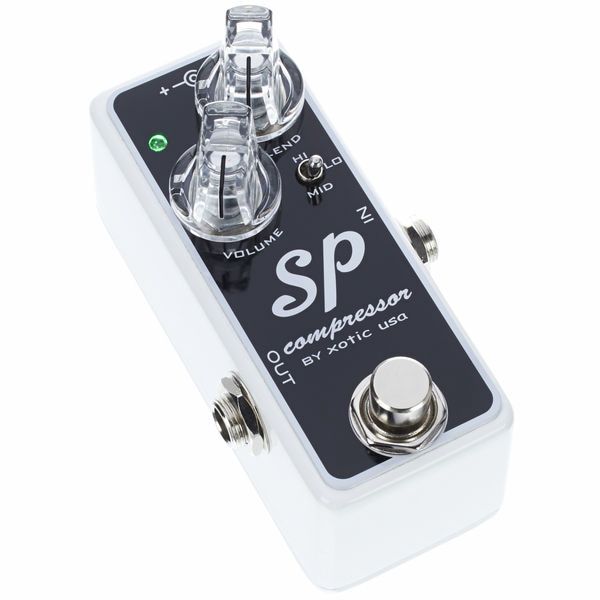
- Type: Compressor, based on the Ross Compressor circuit
- Controls: Volume, Blend, 3-position compression switch
- Internal: DIP switches for attack time adjustment
- Boost: Up to +15dB clean gain
- Bypass: True bypass
- Power: 9V battery or DC (not included)
- Dimensions: 89 x 38 x 38 mm
- Weight: 260g (without battery)
Final Verdict
The Xotic SP Compressor has been a session player favourite for over a decade, and it’s not hard to hear why once you plug in.
It’s not the flashiest pedal, it doesn’t have a screen or presets or anything remotely modern. It just quietly makes your playing tighter and more consistent, which is IMO exactly what a compressor should do.
If you want a compressor that disappears into your tone rather than announcing itself, and you don’t have much board space to spare, this is about as good as it gets at this size.