Watch It First
Marshall’s Origin line gets talked about like it’s some budget afterthought. It’s not.
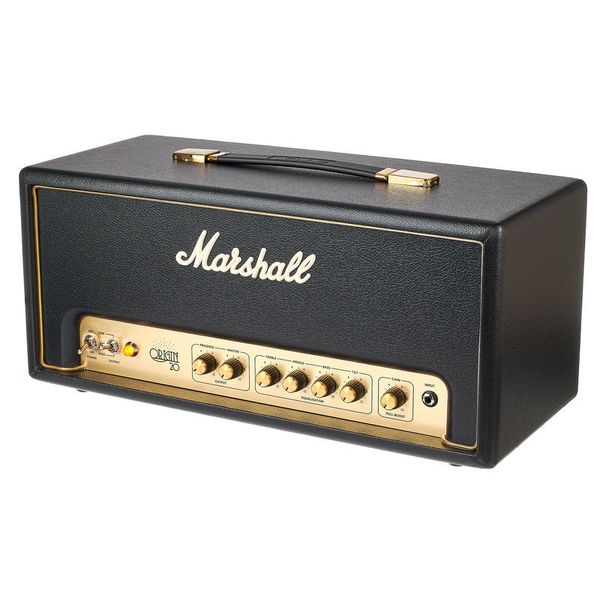
The Origin 20H is a single-channel, 20-watt EL34 head built to chase that JTM45/1987 „Plexi” thing without the four-figure price tag or the collector anxiety.
I spent real time with one, and I get why it’s become the go-to recommendation for players who want vintage Marshall crunch without selling a kidney.
The Idea Behind Origin
Marshall built the Origin series as a purist’s amp – one channel, one gain stage, no digital modeling nonsense.
It leans hard on the classic JTM45 and Super Lead 1987 lineage, but modernizes just enough to make it actually usable: a real Master volume, a switchable Boost, and a proper effects loop.
Marshall also throws in a footswitch in the box for the Boost and FX loop, which is a nice touch most amps this price skip entirely.
Tone – Where It Earns Its Keep
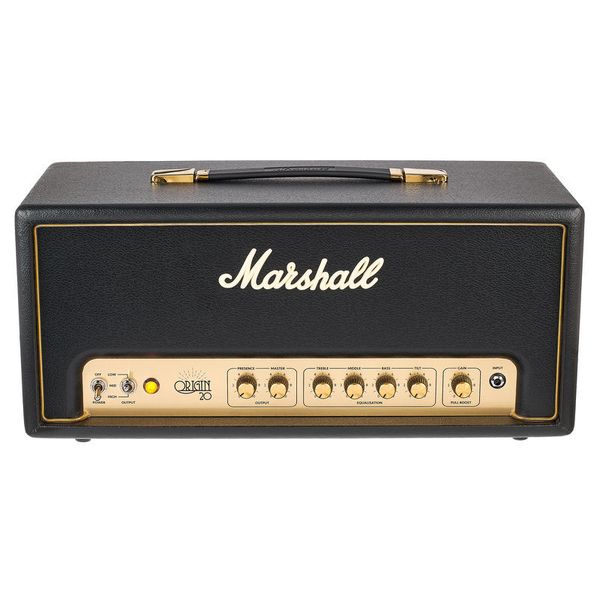
One channel, but it’s a deceptively versatile one thanks to the Tilt control.
Tilt blends between the old „Normal” and „High Treble” inputs from vintage Plexi amps – the ones you used to have to jumper together with a patch cable. Now it’s one knob.
Dial it warm and woolly for blues, or bright and cutting for rock rhythm work. The sweet spot for most players sits somewhere in the middle, and it’s genuinely dynamic – dig in and it snarls, back off your pick attack and it cleans up nicely.
Cab pairing matters a lot here too. Run it through a closed-back 4×12 loaded with Vintage 30s and it turns into a proper rock roar; pair it with an open-back 1×12 or 2×12 instead and you get a woodier, more vintage-leaning voice that a lot of blues players actually prefer.
The Boost Switch
Pull the volume knob (or hit the included footswitch) and gain jumps noticeably without changing your core tone.
It’s not a metal amount of gain, to be clear – this thing tops out at classic rock/hard rock territory. If you need genuine high-gain, this isn’t your amp; check our roundup of tube amps built for metal instead.
Build Quality
Made in Vietnam (like most of the current Marshall lineup outside the handwired reissues), but you wouldn’t know it from how it feels.
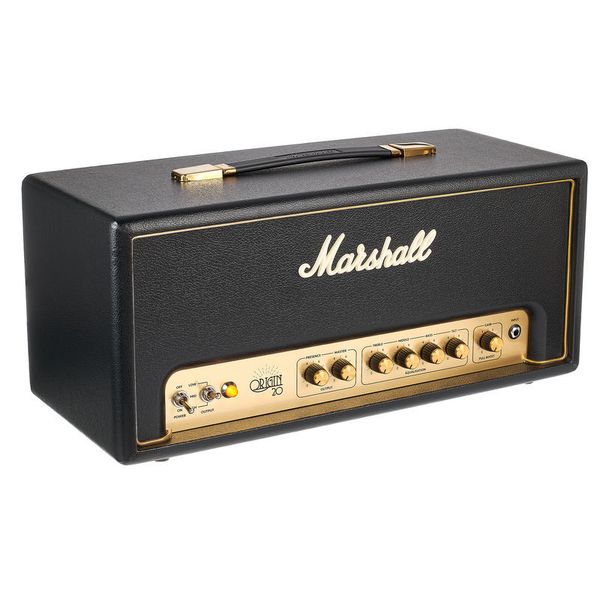
At 9.4kg it’s light enough to carry with one hand into a venue. Classic black Marshall vinyl, gold piping, the script logo – it looks like a proper Marshall, not a budget knockoff wearing the badge.
Some owners mention the pots and switches feel a touch cheap compared to older hand-wired Marshalls. Fair criticism, but at this price point I’d call it a non-issue – nothing here feels like it’ll fail on you mid-gig.
Who’s This For
Rock and blues players who want the real Marshall thing – real tubes, real dynamics, no presets to scroll through.
It’s also a legit pedal platform. Stack a good overdrive pedal in front of it and you can push it well past its native gain range without it turning to mud – the preamp stays articulate even when you’re slamming the front end.
Not for metalheads chasing scooped high-gain, and honestly not for total beginners either – this rewards players who already know how to use their guitar’s volume knob and picking dynamics to shape tone.
Playability and Usability
Three power settings: 20W, 3W, and 0.5W. That bottom setting is a genuine bedroom option – you can get real tube saturation at a volume that won’t get you evicted.
DI out on the back is a small but useful addition for home recording or silent stage setups. FX Send/Return is a proper series loop, not some half-baked effects blend circuit.
Three speaker outs (16 ohm/8 ohm combos) mean it plays nice with basically any cab you own.
It’s also a genuinely great practice-amp option for anyone who already gigs with something bigger – drop it in the car boot as a backup head, or keep it at home for writing sessions where you still want real tube feel instead of a modeler.
Being Honest About The Cons
- Single channel means no dedicated clean – you’re managing everything with guitar volume and the Boost switch.
- Some players find it a bit bright/harsh on the top end straight out of the box, especially paired with brighter single coils.
- Own gain isn’t massive – if you want amp-only saturation without pedals, this won’t fully satisfy you.
- No reverb, obviously, since it’s a purist single-channel design – factor in a pedal.
- EQ pots reportedly aren’t the most sensitive across their range, according to a chunk of owner reviews.
How It Stacks Up
Against the Marshall DSL20HR, the Origin 20H is the more purist choice – DSL gives you two footswitchable channels and more built-in gain, Origin gives you more vintage authenticity and dynamics.
If you’re torn between British-voiced budget heads generally, our piece on whether Bugera amps are actually good is worth a read for a cheaper angle on the same idea.
And if it’s more headroom for pedals you’re after rather than amp-only grind, our guide to overdrives for British-voiced amps pairs surprisingly well with this head too, even though it was written with Vox in mind.
Specs At A Glance
- Power: 20W, switchable to 3W / 0.5W
- Channels: 1, with Gain Boost function
- Preamp tubes: 3x ECC83 (12AX7)
- Power tubes: 2x EL34
- Controls: Gain, Tilt, Bass, Middle, Treble, Master, Presence
- Connections: Input, DI Out, FX Send/Return, Footswitch jack
- Speaker outs: 3x jack (16Ω / 8Ω combos)
- Footswitch: included in the box
- Dimensions: 520 x 225 x 220 mm
- Weight: 9.4 kg
Final Verdict
The Origin 20H does one thing and does it very well: proper vintage Marshall crunch, at a price that doesn’t require a second job.
Add in the power scaling down to 0.5W, the included footswitch, and a build that punches above its price tag, and it’s easy to see why it’s become such a common recommendation in gear forums.
If you want a single-channel purist rig that rewards dynamics over presets, this is basically a no-brainer. If you need multiple footswitchable voicings or heavy built-in gain, look elsewhere – but for what it’s designed to do, it nails it.